
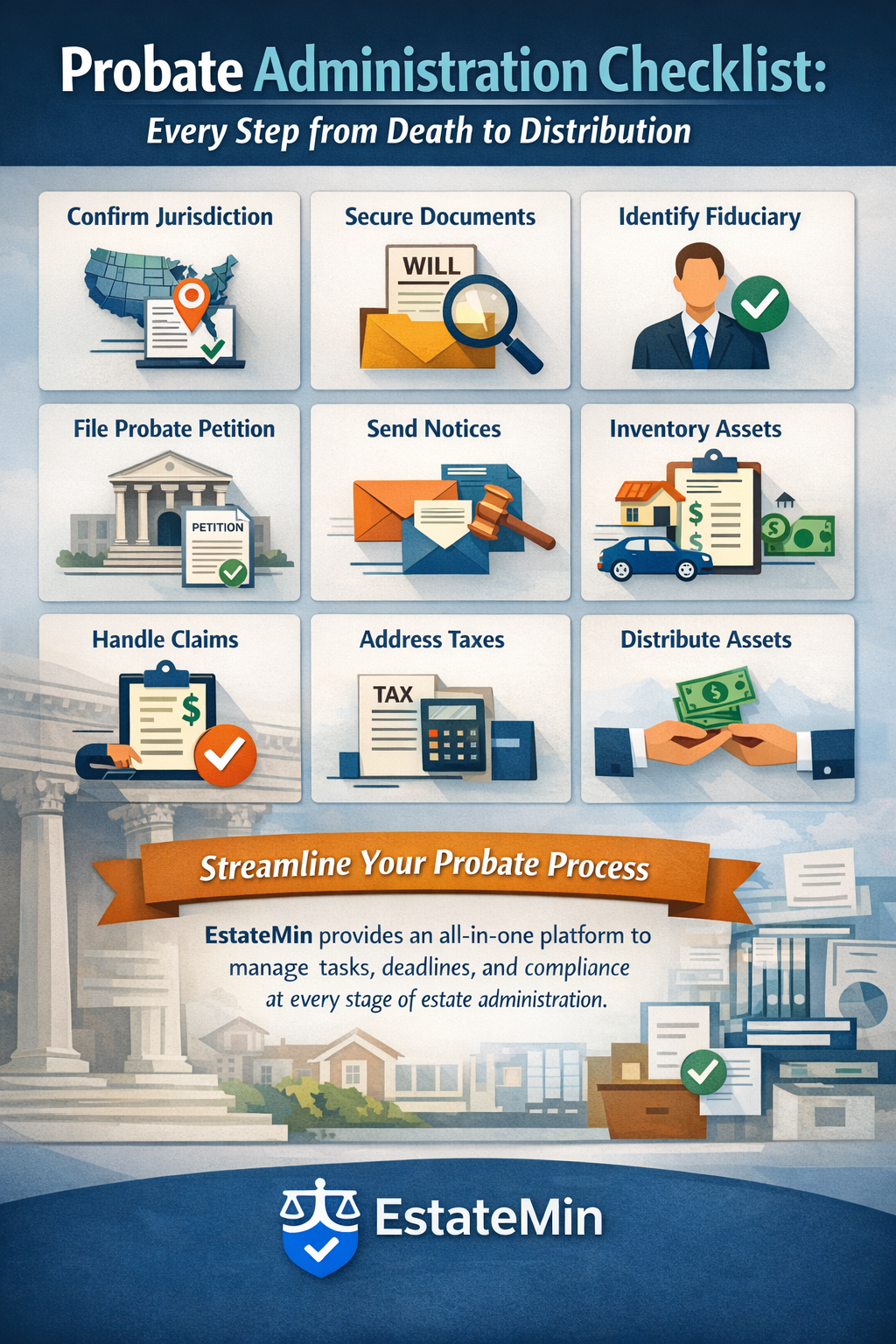
Probate administration requires structured execution, disciplined documentation, and strict deadline control across multiple procedural stages. When managing court-supervised estates, each omission or delay increases exposure the fiduciary and compounds workload pressure on the legal team handling the file. A comprehensive probate administration checklist serves as an operational framework that promotes consistency, reduces risk, and supports efficient case management from initial intake through estate closure.
This presents a step-by-step probate administration checklist designed for U.S. probate attorneys, paralegals, and legal staff responsible for day-to-day estate administration. The focus remains on filings, timelines, documents, internal controls, and workflow coordination rather than beneficiary education. Each section reflects how probate administration functions inside active law firm environments. Tools like EstateMin help probate teams operationalise this checklist by streamlining client intake through a secure client portal, alongside task management, document control, and deadline tracking across every stage of administration.
Immediate Post-Death Intake and Case Setup
Confirm Jurisdiction and Probate Necessity
- Determining jurisdiction requires confirming the decedent’s legal domicile at the time of death, which controls venue and applicable probate statutes. This step also involves identifying real property located in other states, which may trigger ancillary probate proceedings and additional court oversight. Early jurisdictional analysis prevents duplicative filings and avoids procedural conflicts between courts.
- Evaluating whether probate administration is required depends on asset structure, beneficiary designations, and statutory thresholds for small estate procedures. Non-probate transfers such as joint tenancy, payable-on-death accounts, and trust-held assets must be excluded from the probate estate calculation. Misclassification at this stage often leads to unnecessary filings or overlooked court requirements.
- Estimating the gross estate value provides guidance on procedural complexity, bond requirements, and reporting obligations. Asset values should be assessed conservatively using available statements and ownership records. This estimate supports early workload planning and staffing allocation within the firm.
Secure Foundational Documents
- Certified death certificates must be obtained promptly, as financial institutions, insurers, and courts rely on them for verification. Multiple certified copies are typically required due to parallel administrative processes. Delays in securing certificates frequently stall asset access and court filings.
- The original last will and testament must be located and reviewed for execution validity, witness requirements, and self-proving affidavits. Codicils should be evaluated in chronological order to confirm which provisions control distribution. Any irregularities should be flagged immediately for potential evidentiary issues.
- Ancillary documents such as marriage certificates, divorce decrees, and trust instruments provide context for spousal rights and dispositive schemes. These records often affect elective share claims and intestacy analysis. Early document consolidation reduces later investigative delays.
Identify the Proposed Fiduciary
- The nominated executor or administrator must be evaluated for eligibility under state law, including residency and age requirements. Certain jurisdictions restrict non-resident fiduciaries or impose bonding mandates. Addressing these issues early prevents appointment delays.
- Willingness to serve should be confirmed in writing to avoid mid-administration resignations. Scheduling conflicts, health concerns, or family disputes often surface at this stage. Documenting acceptance supports court filings and internal accountability.
- Conflicts of interest must be assessed carefully, especially when fiduciaries are also beneficiaries or creditors. Disclosure obligations vary by jurisdiction but failure to address conflicts increases litigation exposure. Early risk identification protects both the fiduciary and the firm.
Petition for Probate and Court Appointment
Prepare the Probate Petition
- The probate petition initiates court supervision and establishes the framework for administration. Accuracy in identifying heirs, devisees, and asset estimates is critical, as errors propagate through subsequent filings. Courts often scrutinize petitions closely in contested matters.
- Required information typically includes the decedent’s identifying details, domicile, and testamentary status. Supporting facts must align precisely with attached documentation. Inconsistencies increase the likelihood of court rejection or amendment requests.
- Petition drafting should account for local court formatting rules and judge-specific preferences. Failure to comply with procedural nuances frequently results in avoidable continuances. Standardized templates help maintain consistency across filings.
File Supporting Documents
- The original will must be lodged with the court in accordance with statutory requirements. Courts often require affidavits explaining custody of the will prior to filing. Proper handling reduces challenges to authenticity.
- Fiduciary oaths, acceptances, and bond applications establish authority and compliance. Bond waivers must be supported by clear testamentary language or statutory authorization. Errors in bond calculation can delay issuance of letters.
- Proposed orders should mirror petition language exactly to avoid clerical discrepancies. Judges often sign orders without modification, making precision essential. Internal review protocols reduce correction cycles.
Issue Letters Testamentary or Letters of Administration
- Letters confer legal authority to act on behalf of the estate. Financial institutions routinely reject outdated or uncertified letters. Maintaining current certified copies prevents transactional delays.
- Some jurisdictions impose expiration periods or renewal requirements. Tracking these dates ensures uninterrupted fiduciary authority. Lapsed letters can invalidate transactions.
- Internal file checklists should confirm receipt and distribution of letters. Centralized storage supports quick retrieval for third-party verification. This step marks the operational start of administration.
Notice Requirements and Interested Party Management
EstateMin supports this step by maintaining a centralized record of heirs, devisees, and notice recipients, reducing the risk of omission.
Provide Statutory Notice
- Statutory notice requirements protect due process rights of interested parties. Identifying all required recipients requires careful review of intestacy statutes and testamentary provisions. Omitted parties create jurisdictional defects.
- Methods of service vary by recipient classification and location. Certified mail, personal service, or publication may apply. Selecting the correct method avoids later objections.
- Timing of notice often triggers additional deadlines. Miscalculation extends administration timelines unnecessarily. Calendar integration remains essential.
File Proof of Service
- Courts require documentary evidence that notice obligations were satisfied. Affidavits must reflect accurate service details and dates. Incomplete proofs delay proceedings.
- Publisher affidavits confirm compliance with publication statutes. Retaining copies supports later challenges. Loss of proof complicates case closure.
- Maintaining a notice log supports internal audits. This log also assists during contested hearings. Documentation discipline reduces litigation risk.
Asset Identification, Control, and Valuation
EstateMin enables firms to store proofs of service, publication affidavits, and service logs in a single location tied directly to the matter, reinforcing documentation discipline and reducing litigation risk.
Marshal Estate Assets
- Asset identification requires systematic investigation of financial records and ownership interests. Overlooking assets compromises fiduciary duties. Comprehensive searches prevent later amendments.
- Securing assets protects against unauthorized transfers and loss. Immediate action is required for cash accounts and valuable personal property. Delay increases exposure.
- Documentation of asset control supports fiduciary accountability. Courts expect demonstrable oversight. Clear records simplify accounting preparation.
Establish Estate Accounts
- Estate accounts segregate fiduciary funds from personal assets. Banks require precise documentation for account opening. Missing paperwork causes delays.
- All estate transactions should flow through designated accounts. This practice supports transparent accounting. Commingling constitutes fiduciary breach.
- Monthly reconciliations reduce errors. Regular review identifies discrepancies early. Strong controls protect against disputes.
Obtain Date-of-Death Valuation
EstateMin centralizes valuation documents and appraisal reports while maintaining consistent valuation methodology across assets, reinforcing credibility and court acceptance.
- Date-of-death values establish the baseline for tax reporting and distribution. Accurate valuations reduce later objections. Professional appraisals support defensibility.
- Market accounts rely on statements reflecting closing prices. Documentation should be retained. Missing statements complicate inventory filings.
- Valuation methodology should be consistent. Inconsistencies raise credibility concerns. Standard practices support court acceptance.
Inventory and Appraisal Filings
Prepare the Formal Inventory
- Inventories summarize estate assets under oath. Courts enforce strict filing deadlines. Late filings invite sanctions.
- Each asset must be described with sufficient specificity. Vague entries trigger court inquiries. Precision supports transparency.
- Review for completeness before filing. Amendments increase workload. Quality control reduces rework.
Coordinate Appraisal
EstateMin supports proactive follow-up by tracking appraisal status and deadlines alongside other inventory tasks, reducing bottlenecks and maintaining predictable administration timelines,
- Court-appointed appraisers require timely coordination. Access to assets must be facilitated promptly. Delays affect filing deadlines.
- Private appraisers must meet statutory standards. Engagement letters should define scope clearly. Proper documentation supports valuation.
- Track appraisal delivery dates. Missing reports delay inventory submission. Proactive follow-up prevents bottlenecks.
Creditor Administration and Claims Resolution
Publish Notice to Creditors
- Creditor notice publication initiates claim periods. Statutory compliance is mandatory. Incorrect publication invalidates notice.
- Approved publications vary by jurisdiction. Selection must follow court rules. Deviations extend creditor exposure.
- Retain proof of publication. Courts require affidavits. Documentation supports claim cutoff enforcement.
Receive and Evaluate Claims
- Each claim must be logged upon receipt. Tracking supports deadline enforcement. Missing claims create disputes.
- Claims require substantive evaluation for validity. Supporting documentation should be reviewed carefully. Improper approval exposes fiduciaries.
- Rejected claims trigger response deadlines. Formal notice must be issued timely. Failure allows claims to proceed.
Pay Approved Claims
- Payments must follow statutory priority. Deviating exposes fiduciaries to surcharge. Careful sequencing prevents error.
- Maintain payment records for accounting. Each disbursement should be documented. Transparency supports court review.
- Retain receipts from creditors. Proof of payment closes liability. Missing records complicate final accounting.
Tax Compliance and Clearance
Address Federal Tax Obligations
- Final income tax returns must reflect pre-death income. Coordination with tax professionals supports accuracy. Errors delay administration.
- Fiduciary income tax returns apply when estates generate income. Filing thresholds must be monitored. Late filings incur penalties.
- Estate tax filings require precise valuation support. Even non-taxable estates demand analysis. Documentation protects against audit risk.
Address State Tax Requirements
- State estate or inheritance taxes impose additional filings. Requirements vary widely. Local expertise remains critical.
- Clearance certificates may be required before distribution. Failure blocks estate closure. Tracking status prevents delays.
- Retain tax correspondence. Courts may request proof. Organized records support discharge petitions.
Ongoing Estate Management
Manage Real Property
- Real property requires insurance coverage maintenance. Lapses expose estates to loss. Policies should be reviewed promptly.
- Ongoing expenses must be paid timely. Utilities and taxes affect value. Neglect reduces sale proceeds.
- Court approval may be required for sales. Compliance avoids invalid transfers. Procedural accuracy remains essential.
Handle Litigation and Disputes
- Contested matters disrupt standard timelines. Separate tracking ensures deadlines are met. Litigation calendars must be integrated.
- Discovery and hearings increase workload. Resource allocation should be adjusted. Clear task assignments reduce confusion.
- Settlement authority often requires court approval. Documentation must be precise. Errors delay resolution.
Accounting and Distribution Preparation
Prepare the Final Accounting
- Final accountings summarize all estate activity. Courts scrutinize accuracy closely. Errors invite objections.
- Accounting formats are jurisdiction-specific. Compliance with templates avoids rejection. Consistency supports clarity.
- Internal review reduces correction cycles. Peer checks identify discrepancies. Quality control protects credibility.
Obtain Court Approval
- Court approval authorizes distribution. Proposed orders must align with accounting figures. Inconsistencies cause delay.
- Waivers may simplify approval when permitted. Documentation must be complete. Missing waivers trigger hearings.
- Calendar approval hearings carefully. Missed dates prolong administration. Diligence ensures progress.
Asset Distribution and Estate Closure
Execute Distributions
- Distributions must follow court authorization precisely. Deviations create liability. Verification prevents error.
- Obtain receipts from recipients. Releases document completion. Retention supports final filings.
- Confirm tax clearances before distribution. Premature payments expose fiduciaries. Final checks protect compliance.
File Closing Documents
- Closing filings formally discharge the fiduciary. Courts require complete documentation. Missing items delay closure.
- Retain records per firm policy. Post-closure inquiries are common. Organized archives support response.
- Confirm estate status as closed. Administrative tasks should cease. Final review ensures completion.
Organizational Systems and Workflow Control
High-volume probate practices rely on structured workflows, centralized task tracking, and consistent documentation standards to manage court-imposed deadlines and fiduciary obligations. Without dedicated systems in place, deadline management becomes fragmented, visibility across matters is reduced, and risk exposure increases as cases scale.
EstateMin is used by probate law firms to provide a centralized workflow environment designed specifically for probate administration. By consolidating task sequencing, filing deadlines, document management, asset records, and notice tracking within a single system, EstateMin helps firms maintain procedural consistency across estates while reducing administrative overhead and compliance risk.
Conclusion
Probate administration requires disciplined execution across multiple procedural stages, from court appointment through final discharge of the fiduciary. A detailed probate administration checklist supports consistency, reduces operational risk, and enables law firms to manage estates efficiently under court supervision.
When paired with structured systems such as EstateMin, these processes become easier to execute at scale, supporting compliance, protecting fiduciaries, and enabling predictable, defensible outcomes in modern probate practice.
Disclaimer
The content provided in this article is for general informational purposes only and should not be relied upon as legal advice. EstateMin is a technology provider and does not offer legal services or representation. No attorney-client relationship is formed by accessing this content. While we strive to provide accurate and current information, we make no guarantees regarding completeness, accuracy, or applicability to any particular situation. Readers should consult a licensed attorney for legal advice specific to their circumstances.